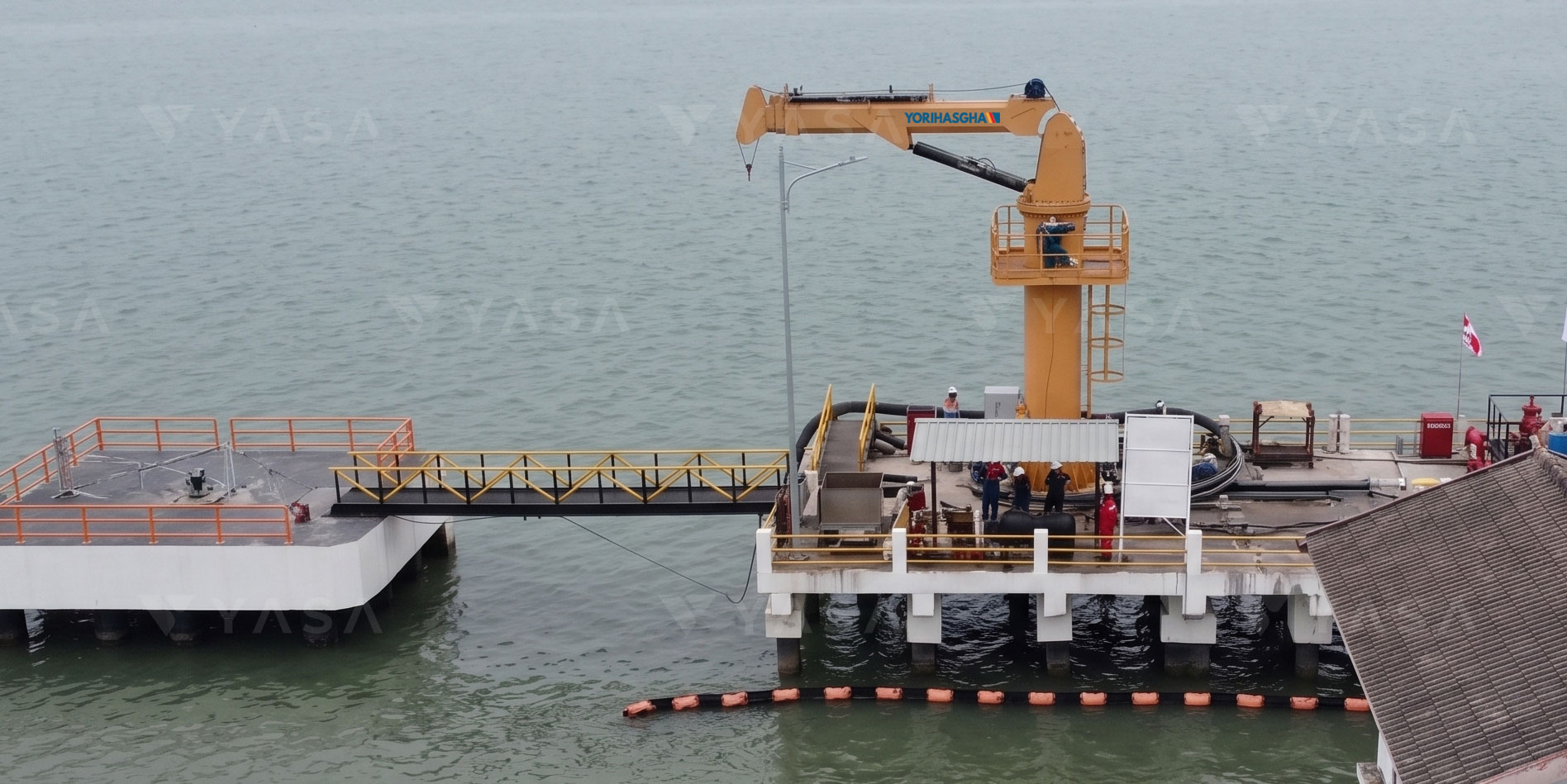
Ensuring the smooth distribution of fuel (BBM) demands a high level of accuracy and absolute safety standards. In 2024, PT Yasa Persada Engineering (YASA) completed the installation of a Telescopic Marine Hose Crane at a vital jetty facility owned by a prominent national state-owned energy company in Surabaya, East Java. This project underscores the reliability of YASA’s Heavy Lifter Fleet services and the company’s capabilities in Civil & Heavy Construction, particularly in executing installations within high-risk environments.
This strategic jetty serves as a critical hub for the receipt and distribution of fuel, accommodating massive tankers with capacities of up to 35,000 Deadweight Tonnage (DWT). To facilitate efficient loading and unloading operations, the facility requires the precision of a 3-ton capacity Telescopic Crane. This heavy equipment plays a crucial role in lifting and positioning heavy cargo hoses and ship access ladders, connecting the jetty structure directly to the tanker’s manifold.
To account for tidal dynamics and the constant fluctuations in a vessel’s draft, the installed crane features a specialized geometry: a 9-meter-tall tower and an outreach (boom reach) of 12 meters.
Beyond mere lifting capacity, the primary challenge lies in environmental safety. Given that a fuel jetty is a highly sensitive area, YASA ensured that all installed electrical specifications fully complied with the required safety standards.
The successful completion of this technically demanding installation—which required the utmost caution—is a tangible reflection of the core values that form the foundation of YASA. As a "One-Stop Solution" provider, YASA’s capabilities extend far beyond simply supplying heavy equipment. We deliver certainty in execution, seamless logistics, and expert construction engineering—all integrated into a robust framework of operational efficiency.